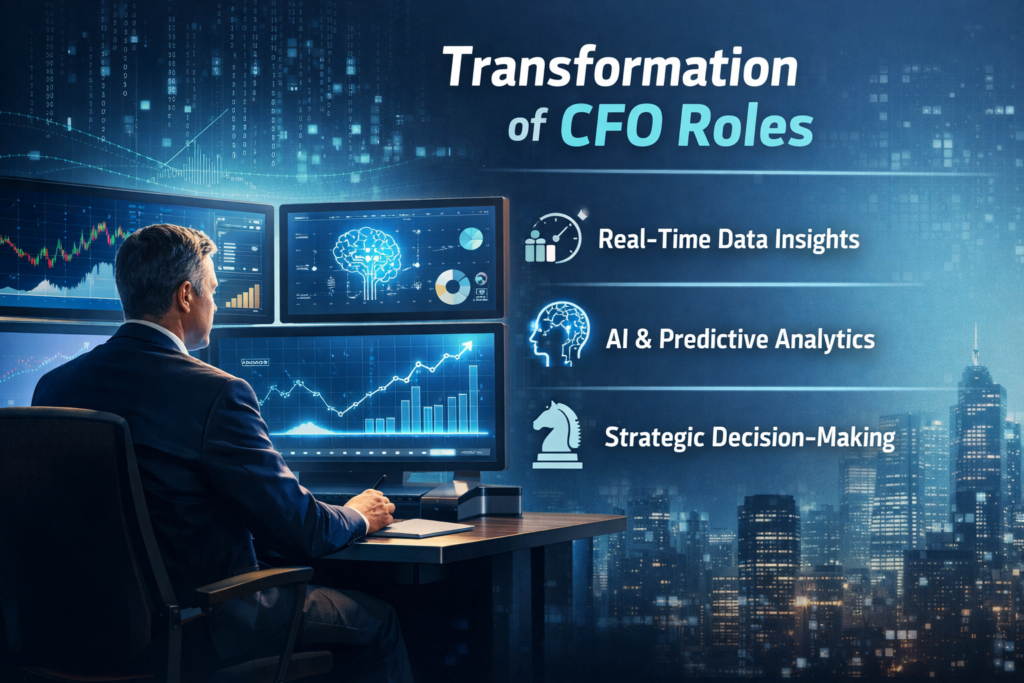
The role of the Chief Financial Officer (CFO) has undergone a profound transformation over the past decade. Traditionally viewed as the guardian of financial reporting, compliance, and cost control, today’s CFO is emerging as a strategic leader—leveraging real-time data, advanced analytics, and artificial intelligence (AI) to shape business direction and long-term value creation.
In 2026, the finance function is no longer backward-looking. It is predictive, data-driven, and deeply integrated into enterprise strategy.
Key Professional Points
1. Shift from Reporting to Strategic Decision-Making
The role of finance leadership has expanded beyond traditional financial reporting to a more strategic function. Instead of focusing only on past performance, CFOs now use predictive analytics to forecast trends and guide future planning. They actively contribute to corporate strategy, long-term growth planning, and major business decisions such as mergers, acquisitions, and capital investments.
2. Adoption of Real-Time Data Systems
Modern finance functions rely on cloud-based ERP systems and integrated digital platforms to provide instant financial visibility. Continuous monitoring of cash flow, revenue streams, and operational metrics enables faster and more informed decision-making. Real-time data allows organizations to respond quickly to market fluctuations and emerging risks.
3. Integration of Artificial Intelligence in Finance
Artificial intelligence enhances forecasting accuracy and supports advanced scenario analysis. Automation of routine financial processes such as reconciliations, invoice processing, and expense tracking improves efficiency and reduces human error. Machine learning tools also strengthen fraud detection and risk assessment capabilities.
4. Enhanced Risk Management Capabilities
Finance leaders now use real-time dashboards and data analytics to identify and mitigate risks proactively. Automated compliance systems ensure adherence to regulatory standards while reducing manual oversight. Strengthened internal controls supported by digital tools improve transparency and accountability.
5. Leadership in Digital Transformation
CFOs play a central role in driving digital transformation initiatives. By collaborating with IT and operational teams, they support system modernization and process optimization. Building a technology-enabled finance culture ensures long-term sustainability and innovation.
6. Focus on Value Creation and Growth
The finance function now emphasizes strategic capital allocation and investment optimization. Performance metrics are aligned with broader business objectives to drive measurable results. CFOs also support innovation initiatives and sustainable growth strategies that enhance long-term enterprise value.
7. Evolving Skill Requirements
The transformation of finance demands strong data literacy and analytical expertise. Modern CFOs require cross-functional leadership skills to collaborate effectively across departments. Continuous learning in AI, analytics, and emerging digital technologies has become essential.
8. Cultural and Organizational Transformation
Finance teams are evolving into agile and collaborative units that work closely with other business functions. Encouraging data-driven decision-making across departments strengthens organizational alignment. The shift from a control-focused mindset to a strategic partnership approach defines the new finance leadership model.
Conclusion
The transformation of the CFO and finance function reflects the broader digital evolution of global businesses. By leveraging real-time data, automation, and artificial intelligence, finance leaders are transitioning from traditional financial guardians to strategic architects of growth. Organizations that successfully embrace this shift gain improved operational efficiency, stronger risk management, and a sustainable competitive advantage in a rapidly changing business environment.
Leave a Reply